
Challenge
How to Start a Yodoku Puzzle When Nothing Looks Obvious
Every puzzle in Yodoku’s 9,999-puzzle campaign can be solved using logic, without a single guess. An empty board can hide the next deduction, but it never asks you to pick a square and hope.
Instead of asking where a lantern goes, ask what would stay true whichever square you chose.
In Yodoku, every row, every column, and every colored garden bed needs exactly one lantern. Lanterns can’t touch, even diagonally. Those rules can tell you something useful before they tell you where to place anything.
Puzzle 10 is a good example. Nothing is filled in, and the first lantern isn’t obvious. Start with the garden that gives you the fewest choices, then look for what those choices have in common.
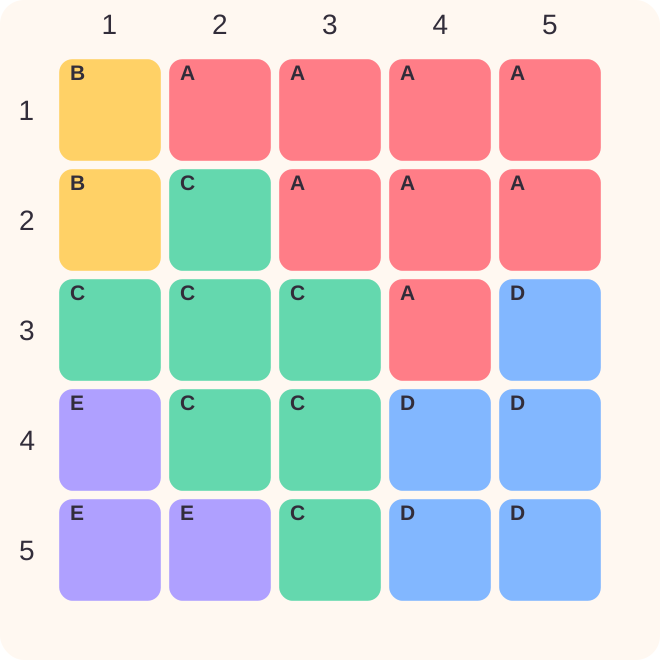
Region letters: A pink · B yellow · C green · D blue · E purple.
Start with the fewest choices
The yellow bed has just two squares, fewer than any other garden on this board. It’s a useful place to look, but you still can’t choose between them.
You don’t need to. They’re both in column 1.
If the lantern goes in yellow’s top square, it uses column 1. If it goes in yellow’s other square, it still uses column 1. Both possibilities make the same fact true.
So every non-yellow square in column 1 is out, even though you haven’t placed anything yet. You haven’t picked one yellow square, tried it, or assumed it was right. This is a proof that works whichever yellow square turns out to hold the lantern.
That’s the question to ask when you’re stuck: what do all the remaining candidates have in common? If a garden’s lantern must land in one row or column, you can rule out that row or column everywhere outside the garden. You’ve learned something without guessing between its candidates.
Follow that fact somewhere else
Now look at purple, in the bottom-left corner. It has three squares. Two are in column 1, so neither can hold its lantern.
There’s only one place left: row 5, column 2. The bottom row, second square from the left. Place your first lantern there.
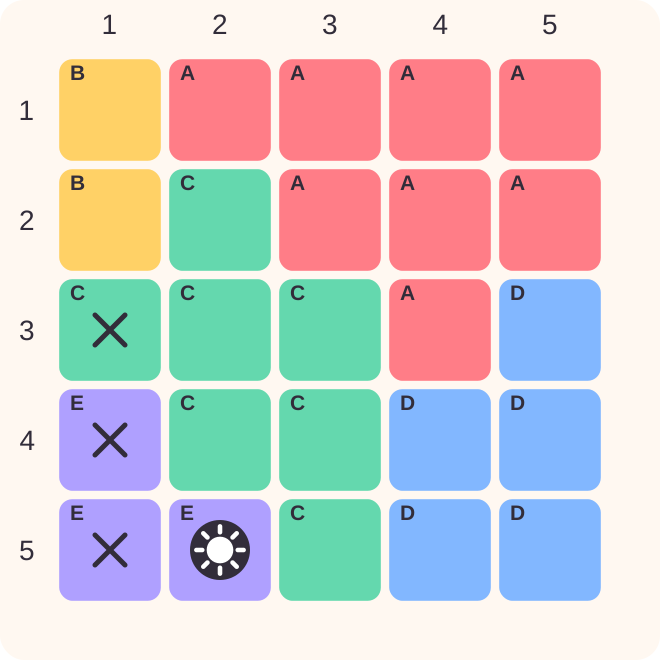
Yellow’s two undecided squares have just solved purple. The place where you learn something doesn’t have to be the place where you make your move.
That’s why hunting only for a garden with one obvious square can leave you stuck. A garden with two or three candidates may already reserve a row or column. Follow that restriction into a neighboring garden and a certain move can appear.
Repeat the process, not the guess
After each lantern, update what’s still possible: rule out the rest of its row, its column, its garden, and the squares it touches. Then look again for the garden with the fewest available squares, which may not be the smallest garden by shape. Compare its remaining candidates, carry any shared restriction into the other gardens, and repeat. If one garden gives you nothing new, try another; a small candidate set is a starting point, not a guarantee.
Try it with green. Purple’s lantern rules out its row, column, and touching squares; yellow still reserves column 1. Apply those facts to green’s remaining squares. Where can green’s lantern go?
Yodoku’s harder campaign puzzles ask you to notice more, not to guess. Every one has a logical path to its solution. The next time an empty board offers no obvious first move, find a choice you don’t have to settle yet, and ask what it already tells you.
If you’re already looking for the next lantern, download Yodoku for iPhone and iPad or Android and finish Puzzle 10. There are 9,999 puzzles to work through, with logical hints for when you want a nudge. Play offline, take your time, and find the next square you’re sure of.