
Devlog
Can You Solve This Puzzle Without Guessing?

I started Yodoku with the idea of a simplified Sudoku: keep the row, column and region logic, and use lanterns instead of digits. Try this little garden before opening the walkthrough.
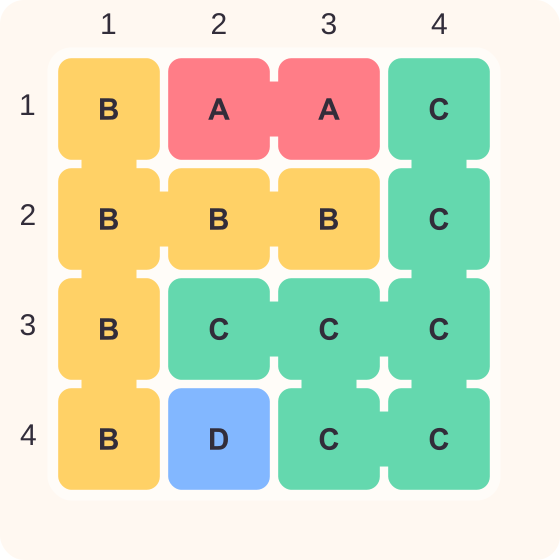
Board description
Four rows and four columns. A is red, B yellow, C green, and D blue. Each letter identifies one connected color region.
- Row 1: B, A, A, C.
- Row 2: B, B, B, C.
- Row 3: B, C, C, C.
- Row 4: B, D, C, C.
The rules
- Place exactly one lantern in each color.
- Place exactly one lantern in each row and each column.
- Lanterns cannot touch, even diagonally.
You’ll place four lanterns in total. Letters identify the color regions, and an X can help you keep track of squares you’ve ruled out.
Take a moment with the board. Which square gives you a certain start?
Just a hint
Find the color that occupies only one square. Then look at the row immediately above it.
Familiar logic, different clues
Classic Sudoku asks you to place each digit once in every row, column and box. Yodoku asks for just one lantern in each row, column and colored region, with one extra constraint: lanterns cannot touch. The question becomes which squares can still hold a lantern.
Minesweeper offers another useful comparison. Its numbers count neighboring mines, helping you eliminate possibilities. In Yodoku, a placed lantern rules out the squares around it. Marking those squares with Xs makes the next deduction easier to see.
If you’ve played Meowdoku or Zoodoku, the row, column and colored-region constraints will feel familiar. Those games place animals; here, you’re lighting a garden.
This small board has one solution. Try to explain your next placement before you make it; the walkthrough follows the logic one lantern at a time.
Read the solution walkthrough
One lantern opens the board
1. Start with the blue square.
Blue D has just one square: row 4, column 2. Every color needs a lantern, so that square must have one.
2. Look one row up.
The blue lantern rules out the first three squares in row 3: one directly above it and two touching it diagonally.
Row 3’s lantern must go in its only remaining square: row 3, column 4.
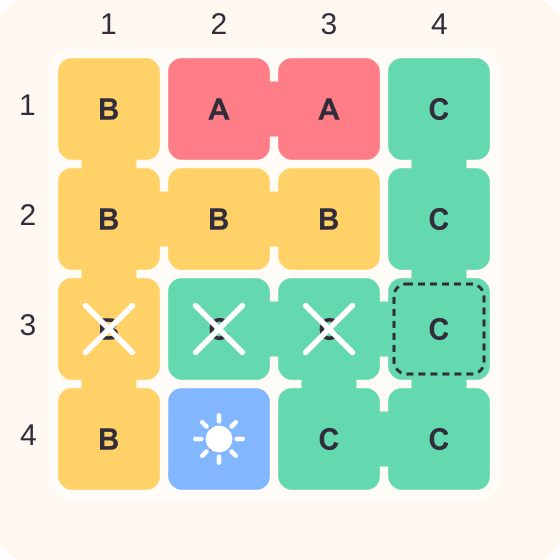
3. Return to the two red squares.
Red A has two squares in the top row. Blue already uses column 2, so red must go at row 1, column 3.
4. Fill the last row and column.
Row 2 and column 1 are the last without a lantern. They meet at the yellow square at row 2, column 1.
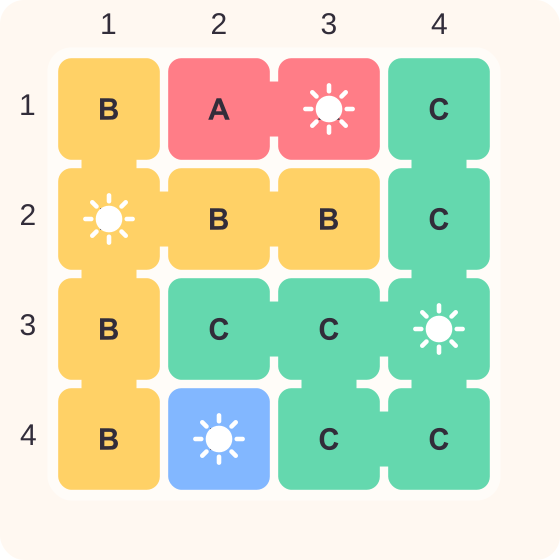
Four lanterns: one in every color, row, and column, with none touching.
Try the garden
Tap to mark X. Hold or double-tap for a lantern.
One lantern per color, row and column. No touching, even diagonally.
0 of 4 lanterns placed.
Want another garden?
Get Yodoku on Google PlayShow all four lanterns? This replaces your marks and reveals the whole answer.
Controls and board description
Tap or click to mark or clear X. Hold or double-tap/click to place or remove a lantern. A tap leaves an existing lantern alone.
Drag from an empty square to add Xs, or from an X to clear them. On touch screens, swipe horizontally to mark; swipe vertically to scroll the article.
Use arrow keys to choose a square. Enter or Space marks X; L places or removes a lantern. Tab leaves the board. Escape cancels a pending gesture.
These buttons offer the same actions without timed gestures.
Row 1, column 1 · Yellow B